

When construction takes place in New York City, developers often require access to neighboring properties. If you’re an adjoining property owner, it’s important to understand your rights and obligations when such access is requested. This guide explains what construction access agreements are, when they’re needed, and how to protect your property. New York rewrote the access law — RPAPL § 881 — in December 2025 and again in February 2026, the first major changes since 1968, and this guide has been updated to reflect the current rules.
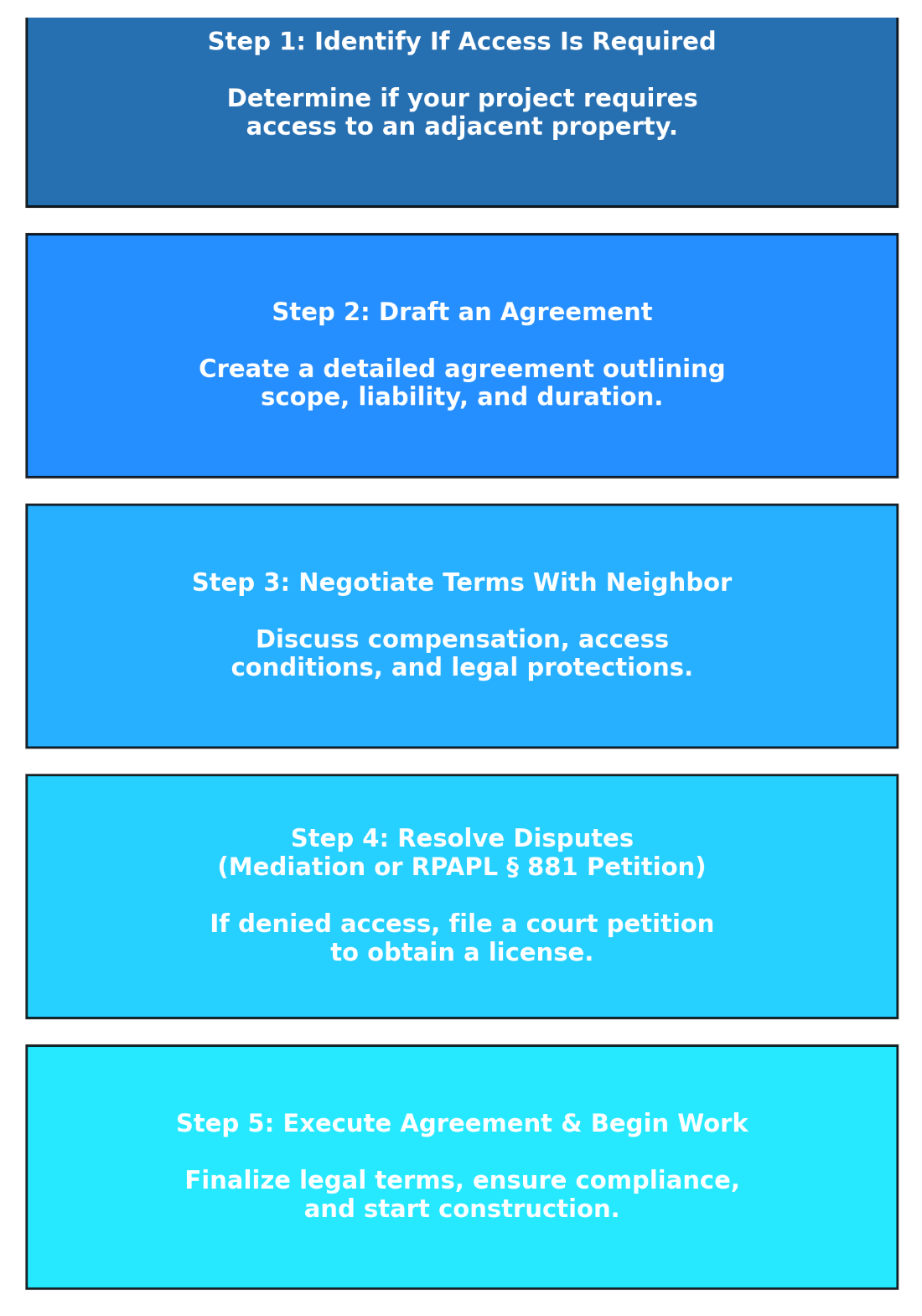
What Is a Construction Access Agreement?
A construction access agreement is a written contract that allows a developer to enter, use, or temporarily occupy a neighboring property to perform construction-related work. This may include:
- Installing protective measures like scaffolding or netting
- Entering your roof, terrace, or yard
- Accessing walls for inspection or repair
These agreements are negotiated between the developer (or property owner conducting the construction) and the adjoining property owner.
When Is an Access Agreement Required?
An access agreement is typically needed when:
- A construction project is occurring within close proximity to a property line
- The work involves excavation, underpinning, or demolition
- Scaffolding, swing staging, or shoring needs to be installed on a neighbor’s property
If you are not willing to grant access voluntarily, the developer may petition the court under RPAPL §881 to obtain a license.
What Is RPAPL §881?
Section 881 of the New York Real Property Actions and Proceedings Law (RPAPL) allows a developer to request a license from the court to access a neighbor’s property when access is reasonably necessary for construction.
The court may grant the license if the work cannot be completed without access and the adjoining owner is unwilling to consent voluntarily. Courts generally impose conditions to protect the neighbor, such as:
- Limiting the duration and scope of access
- Requiring insurance coverage
- Ordering payment of license fees
- Requiring the developer to cover the neighbor’s legal and engineering fees
The Access Law Changed in 2025–2026: Five Things Adjoining Owners Should Know
New York overhauled RPAPL § 881 in December 2025, with a follow-up amendment in February 2026. Most of the changes matter to lawyers; these five matter to you.
1. You can no longer safely ignore an access request.
If a developer sends you more than one written request by certified mail and you don’t respond within 60 days, the law now treats your silence as a refusal — and the developer can go straight to court. Respond in writing, even if it’s just to say your attorney is reviewing the request.
2. Your right to be paid is now in the statute.
Courts can require the developer to pay you reasonable compensation — a license fee — for the intrusion, typically a monthly amount for as long as the protections stay up.
3. The developer pays your review costs.
The statute now says courts can order the developer to reimburse your reasonable costs of having the project documents — plans, engineering reports, insurance — professionally reviewed. Attorney fees for negotiating the agreement aren’t guaranteed by the statute, but courts continue to award them: in April 2026, a Brooklyn court ordered a developer to pay an adjoining owner $67,750 in attorney and architect fees. A good access agreement makes the developer pay these fees directly, so you never have to ask a judge.
4. Tiebacks and underpinning can now be forced on you — sometimes.
Courts can now license permanent installations in your property — underpinning, tieback anchors, wall ties — but only where they’re required by code or law. Whether that’s actually true for a given project is a question for your engineer, and permanent installations deserve meaningfully more compensation than temporary scaffolding. Never agree to them without independent review.
5. The insurance protection got weaker — so negotiate it back.
The original December 2025 law required developers to name you as an additional insured on their liability policy. The February 2026 amendment watered that down: developers now only have to give you proof of insurance sufficient to make a claim if damage occurs. That’s a floor, not a ceiling — you can and should still demand additional insured status in the agreement itself.
The bottom line: the new law gives developers a faster path to court, and it makes the negotiated access agreement more important than ever. Everything above the statutory minimum — additional insured status, attorney fee payment, real compensation for permanent installations — has to be won at the bargaining table.
Key Terms to Include in an Access Agreement
When negotiating an access agreement, adjoining owners should consider including terms that:
- Limit the scope of access to specific work and areas
- Set strict timeframes and require notice before access begins
- Require insurance with the neighbor named as an additional insured
- Indemnify the neighbor from liability or damage
- Provide license fees to compensate for use of the property
- Cover professional fees, including attorneys, engineers, and consultants
If you need assistance drafting or negotiating an access agreement, James J. Corbett, P.C. can help protect your interests and ensure a fair and effective agreement. Contact us today to learn more our construction access agreement services in NYC.
Why Legal Counsel Is Important
An access agreement is a binding legal contract. Without careful negotiation, you could expose yourself to risk, property damage, or prolonged inconvenience.
Legal counsel ensures:
- The agreement complies with applicable laws and codes
- Your rights are fully protected
- The developer’s obligations are clear and enforceable
At James J. Corbett, P.C., we represent adjoining owners throughout New York City. We negotiate access agreements that protect our clients’ interests, minimize disruption, and ensure fair compensation.
Frequently Asked Questions (FAQ)
Do I have to allow my neighbor access for construction?
No. You don’t have to agree voluntarily unless a court orders it under RPAPL §881. You have the right to set terms.
What happens if I refuse access?
If you refuse access, the developer may file a petition under RPAPL §881. The court will decide if access is necessary and may set conditions.
Who pays the legal and engineering fees for an access agreement?
The developer, in nearly all cases. The 2025 amendments let courts order the developer to reimburse your reasonable costs of reviewing the project documents, and courts continue to award attorney fees for negotiation as well.
What if the developer causes damage?
A well-drafted agreement includes insurance requirements and indemnification clauses to protect you against damage or liability.
Am I entitled to compensation if my neighbor needs access to my property?
Usually, yes. The amended statute expressly allows courts to condition access on reasonable compensation — a license fee — typically paid monthly for as long as the protections remain. The amount depends on how intrusive the work is; minimal, short-term intrusions may not warrant a fee, while permanent installations like underpinning deserve separately negotiated compensation.
What happens if I ignore my neighbor’s request for access?
Under the 2025 amendments, silence is now legally a refusal: two written requests by certified mail plus 60 days without a response lets the developer petition the court, where a judge — not you — sets the terms. Respond promptly and in writing, through counsel, to preserve your negotiating leverage.
Does the developer have to name me as an additional insured?
Not under the statute anymore. A February 2026 amendment replaced that requirement — developers now only must provide documentation letting you make a third-party claim on their insurance if damage occurs. That’s weaker protection, so insist on additional insured status as a term of any negotiated access agreement.
Need Help with an Access Agreement?
Contact James J. Corbett, P.C. to schedule a consultation. We’ll help you understand your rights and negotiate an agreement that works for you.
Call (516) 679-9494 or visit jamesjcorbett.com to learn more.
